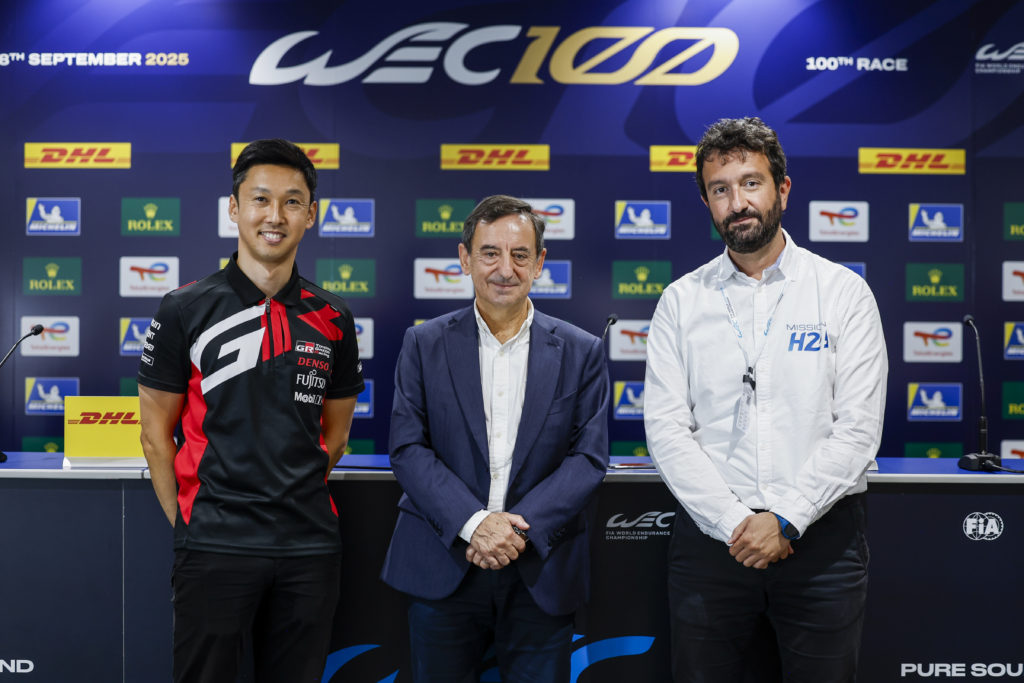


Announced last June at the 24 Hours of Le Mans, the MissionH24 – TOYOTA GAZOO Racing collaboration presents its first renderings and shares its objectives. The aerodynamics and cooling of a prototype using a fuel cell are new research areas in motorsport. The MissionH24 – TOYOTA GAZOO Racing partnership is a pioneer in this field.
When on June 13, 2025, at Le Mans, during the official press conference of the Automobile Club de l’Ouest, Pierre Fillon, Kazuki Nakajima and Bassel Aslan, respectively President of the ACO and Co-President of MissionH24, Vice-Chairman of TOYOTA GAZOO Racing Europe, Technical Director of MissionH24, formalized the MissionH24 – Toyota GAZOO Racing collaboration, the first discussions between the two entities had already taken place some time ago and the work had started a few months earlier.
The goal is clear: TOYOTA GAZOO Racing, with five victories at the 24 Hours of Le Mans and seven FIA World Endurance Championship titles to its credit, will call upon its expert aerodynamics and cooling teams to assist MissionH24 in the development of the H24EVO.
THE H24EVO HAS TWO UNIQUE FEATURES :
- It is equipped with a fuel cell to generate its electricity. Unlike a prototype equipped with a conventional internal combustion engine, the H24EVO cannot use its exhausts to dissipate heat.
- It features specific aerodynamics, resulting from a unique initial design that defines its identity, and the integration of a hydrogen power unit with liquid H2 storage.
MissionH24 and TOYOTA GAZOO Racing have thus established specifications, including the tools provided, the shared data, and the various steps to be taken to achieve the set objectives. Simulation calculations are used to “score” the aerodynamic and cooling efficiency of a racing prototype, still under development. An initial CFD (Computational Fluid Dynamics) study has thus identified the shortcomings of the initial H24EVO design to achieve the ideal aerodynamic and cooling scenario.
Since June 2025, the MissionH24 and TOYOTA GAZOO Racing teams, comprising around ten people, have met weekly.
At this stage, their collaboration has yielded several avenues for modification:
- Larger louvers or opening panels can allow for more efficient extraction of cooling air.
- Clearing the passage under the body for cooling air to reach the rear of the car.
- Re-arranging some misaligned front uprights and reorienting the air intakes also improves cooling capacity.
- Creating a new version of the rear wing, allowing for good downforce and significantly reducing drag.
Two crucial dates and certain tests punctuate the schedule of this collaboration:
- November 2025: Freezing of the skeleton.
- Freezing of the cooling architecture.
- Verifying that the vehicle’s aerodynamics allow for efficient cooling.
- February 2026: Freezing of the H24EVO body.
The first runs of the hydrogen prototype are planned for 2026.
Bassel Aslan, Technical Director of MissionH24: “With the H24EVO, aerodynamics and cooling are two new and crucial themes for the performance of this pioneering hydrogen prototype. The fuel cell and the specific design of the H24EVO require different studies than a conventional combustion engine prototype. Being able to conduct this research with TOYOTA GAZOO Racing is a particularly exciting experience.”
Kazuki Nakajima, Vice Chairman of Toyota GAZOO Racing Europe : “We will help reinforce the MissionH24 project through technical collaboration focused on aerodynamics and cooling systems, leveraging the expertise we have honed in motorsport. ACO is a pioneer of hydrogen in motorsport, and we share their strong commitment. Beyond these technical contributions, we aim to build a partnership that expands the potential of hydrogen not only in racing but also across other fields. At TOYOTA, we believe that achieving carbon neutrality is essential for cars to remain necessary in society, and that multiple options are required to realize it. We will continue to advance hydrogen technology as one of the technologies within our multi‑pathway approach.”